



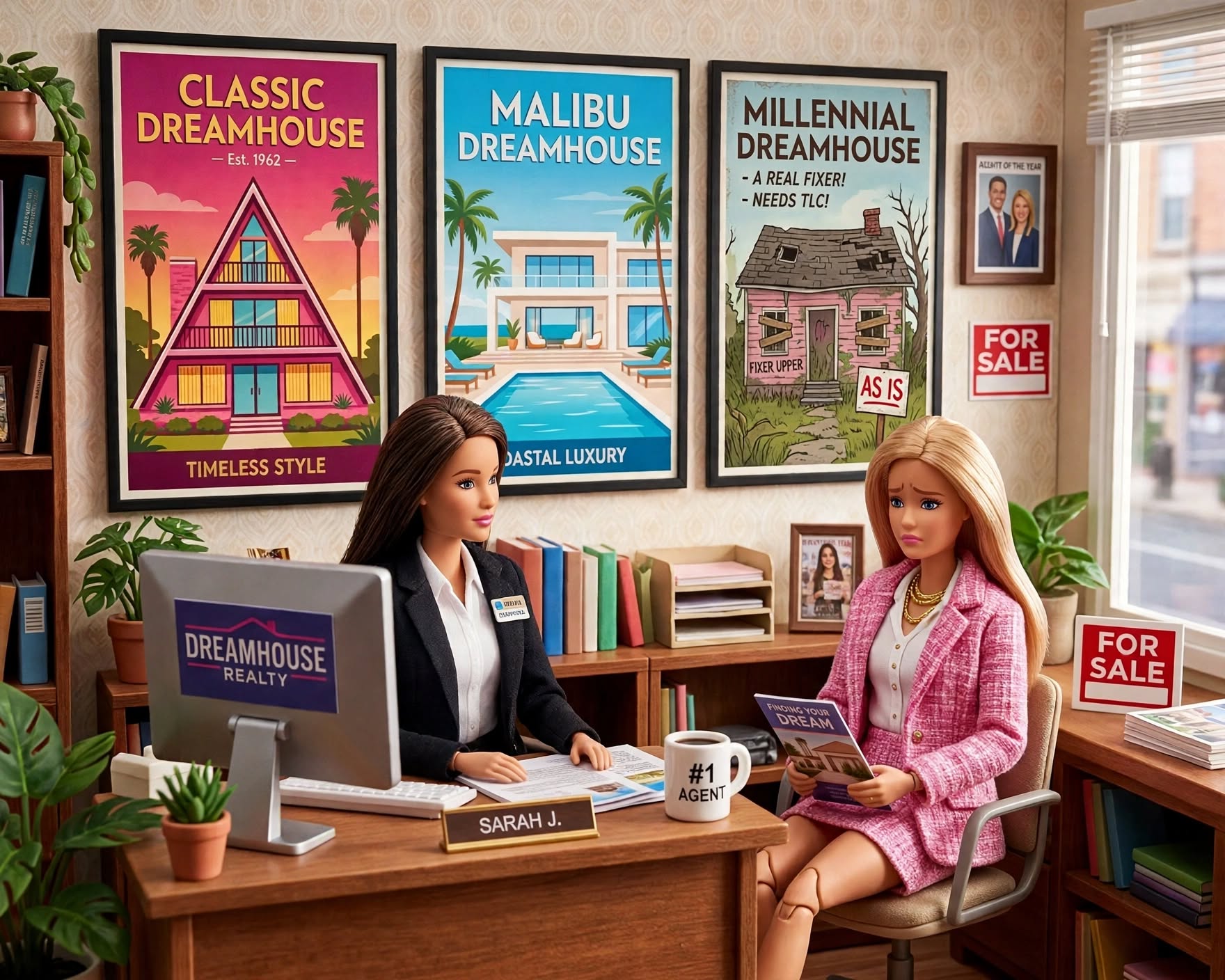


MALIBU, CA — For decades, the American Dream was simple: move to the coast, land an entry-level job as an Astronaut, Surgeon, or Presidential Candidate, and purchase a three-story pink modular mansion complete with an operational elevator and a plastic pool slide. Today, that dream is officially dead. According to a bleak new housing affordability report released Tuesday by the Barbieland Bureau of Economic Statistics, the iconic Malibu Dreamhouse has officially crossed the threshold of “unaffordable” for 94% of the working plastic population. Driven by persistent interest rate hikes, low inventory, and rampant inflation in the synthetic resin sector, the median listing price for a Dreamhouse has surged to an eye-watering 4.8 million Pink Dollars ($PKD)—or approximately 620,000 convertible car trade-ins.
Chief Economist Midge Hadley, who returned to the workforce after being discontinued in 2002, warned that the region is witnessing an unprecedented structural crisis in the residential toy chest. She noted that just ten years ago, a Fashionista Barbie on a single salary could secure a fixed 30-year mortgage on a two-bedroom Pop-Up Camper. Today, even Barbie Careers Nurse is consistently getting outbid by out-of-town Ken cash buyers who do not even possess a clear source of income.
The economic squeeze is hitting every corner of the housing market, with 30-year fixed mortgage rates in Barbieland climbing to 7.8% while property taxes on houses with open-concept walls have skyrocketed. Compounding the issue is an acute shortage of building materials, particularly non-toxic PVC plastic, causing construction on new Townhouses and Glam Campers to stall indefinitely. First-time buyers are virtually priced out, as a standard 1,200-square-foot Beach Bungalow with no working plumbing now receives an average of 42 cash offers within two hours of listing. These offers are frequently waived of all home inspection contingencies, despite known issues like permanent plastic furniture fused directly to the flooring.
Despite holding non-paying jobs described simply as “Beach,” multiple Kens continue to drive up luxury prices by forming syndicated real estate investment groups, snapping up prime oceanfront property to convert into all-pink Mojo Dojo Casa Houses. Younger demographics are bearing the heaviest brunt of this trend. Skipper, 28, who works three gig-economy jobs as a Babysitters Inc. subcontractor, a dog walker, and a freelance DJ, recently gave up on homeownership entirely. She lamented that while her parents’ generation could buy a multi-level Dreamhouse with sound effects and a working toilet just by working a single summer at the Smoothie Bar, her generation works 70 hours a week only to pay $1,800 a month for a cardboard fold-out playset with no running water.
With single-family ownership completely out of reach, lower-income and budget-line Barbies are being forced into increasingly absurd communal living arrangements. In a small studio apartment originally designed as a 1998 Starlight Dance carrying case, six working-class Barbies now live as roommates to split the monthly $3,200 rent. The household includes Barbie Careers Pilot, who despite flying commercial airliners cannot clear her flight school debt, and Fashionistas Doll #249 in Pink Paisley Skirt, who works full-time in retail. They share the tight quarters with Barbie Soccer Doll #16, who plays semi-pro without health benefits, Schooltime Fun Barbie from 1994, a substitute teacher who relies on income from selling thrifted denim vests, and Barbie Baking Fun Doll, who operates an unlicensed bakery out of their single-burner kitchenette. Earring Magic Ken was brought in purely to split the utility bills and currently sleeps in the bathtub.
The roommates maintain strict house rules to survive the congestion. Barbie Careers Pilot explained while sitting on a shared bunk bed that Soccer Barbie gets the sofa from 8:00 PM to 4:00 AM because she works the early shift, while Baker Barbie isn’t allowed to use the toy mixer after 10:00 PM, and Earring Magic Ken must keep all his accessories in a zip-top bag in the hallway. The situation is even grimmer for retired or discontinued lines, as Pregnant Midge and Barbie Video Girl are currently squatting in an abandoned Barbie and Tanner Dog Park playset, relying entirely on Tanner’s magnetic pooper-scooper business just to afford basic groceries.
When asked about the housing crisis during a ribbon-cutting ceremony for a luxury high-rise condominium complex, Stereotypical Ken dismissed claims that the market was rigged against younger dolls. Adjusting his faux-mink coat, Ken suggested that if younger Barbies simply stopped spending all their allowance on iced coffees from the Glam Cafe, vintage pink heels, and premium battery upgrades for their convertibles, they could easily save up a down payment in three to five years. He added that it is all about financial discipline, boasting that he started with nothing more than a surfboard, a smile, and a small seven-figure loan from his parents’ Collector Edition display box.
As the market shows no signs of cooling, grassroots activist groups like Occupy Barbieland are calling for rent control on all plastic fold-out structures and zoning reforms to allow for multi-family duplexes on Mount Lee. Until such reforms take effect, an entire generation of Barbies is coming to terms with a bleak new reality: in 2026, life in plastic isn’t quite as fantastic as advertised.