



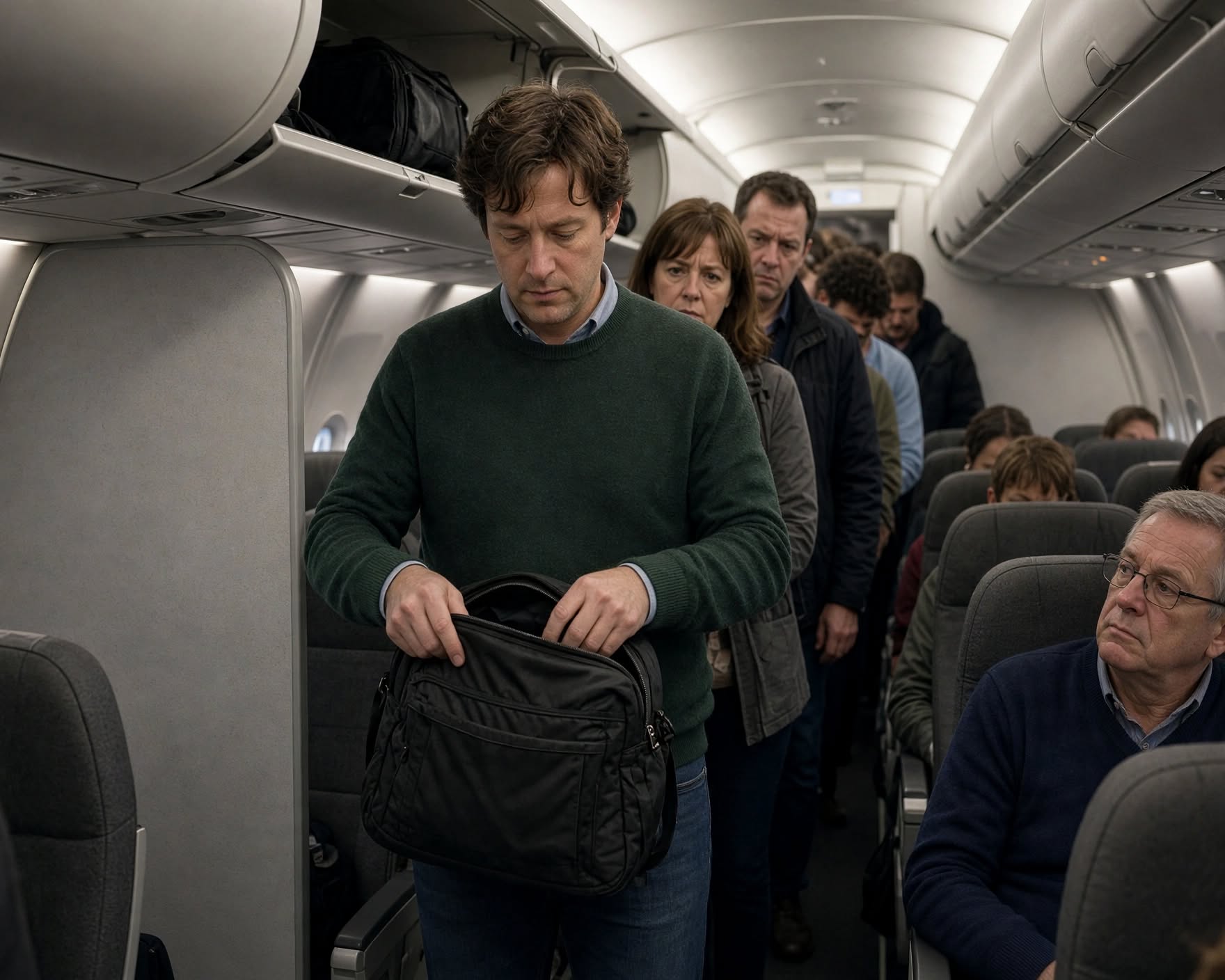


ASHINGTON, DC – According to a recently published report by the Federal Aviation Administration (FAA), 97% of commercial airline passengers (Travelus americanus) are unaware that other people are boarding the plane behind them. The troubling figure represents the highest percentage on record since the FAA began tracking the statistic.
Researchers say the findings provide further evidence of the growing threat to the North American ideal air traveler (Travelus canadus), which the International Union for Conservation of Nature (IUCN) classified as an endangered species last month.
“Commercial airline passengers are classified as an invasive species and were originally confined to a relatively small habitat stretching from Newark to LaGuardia,” said IUCN spokesperson Dan Weber. “But the species has proven remarkably adaptable and can now be found in virtually every major American airport, where it has displaced several native species, including the person who boards, takes their seat and doesn’t bother anyone.”
According to Weber, the most common commercial airline passenger can be identified by a number of telltale behaviors, the most obvious being a complete inability to acknowledge the existence of anyone behind them.
“Researchers have observed these creatures stop directly in the middle of the boarding lane immediately after scanning their boarding passes, then begin searching through their personal belongings,” Weber said. “They appear completely unaware that 40 people are standing directly behind them.”
In other instances, passengers have been observed removing their shoes before even reaching the gate, taking off their shoes again once aboard the aircraft and eventually placing their bare feet through the gaps between the seats in front of them.
“Ideal air travelers are also capable of feeling tired and wanting to stretch their legs,” Weber said. “They simply understand that other people have to exist in the same confined space.”
Despite sharing a common genus, the two species are fierce competitors for the same limited resources, including overhead bin space, armrests and the ability to recline one’s seat three inches.
“It’s very much a zero-sum game,” Weber said. “We’ve documented commercial airline passengers claiming both armrests while simultaneously reclining their seats, speaking loudly on the phone and standing in the aisle during boarding. The ideal air traveler is simply not equipped to compete.”
Weber said the IUCN is particularly concerned about the species’ increasingly aggressive approach to overhead storage.
“Commercial airline passengers will routinely stand in the aisle several rows away from their assigned seats and attempt to force a suitcase into an overhead bin that is already full,” he said. “They then become visibly confused when someone asks them to keep moving.”
Despite the grim outlook for the long-term health and sustainability of the ideal air traveler, Weber said the IUCN has launched a final conservation effort.
“We’re calling it the Stow in Yo’ Row™ campaign,” he said. “The goal is to educate commercial airline passengers that they can simply keep walking to their seats and put their luggage in the overhead bin there.”
Researchers cautioned that the campaign faces significant challenges.
“We’ve found that most commercial airline passengers are capable of understanding this concept,” Weber said. “They just don’t seem to believe it applies to them.”