



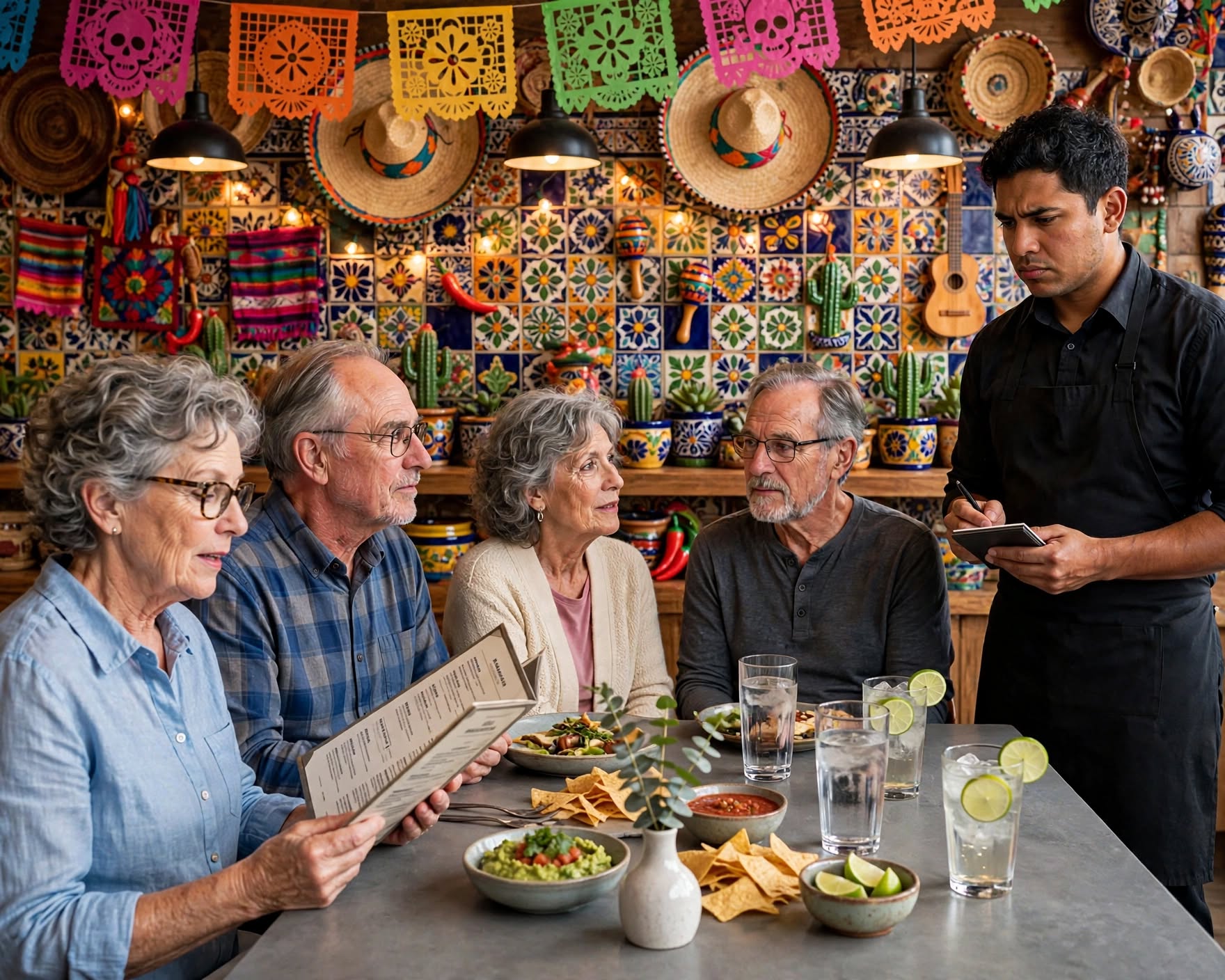


THE VILLAGES, FL — A server at Casa del Sol, a Mexican restaurant in The Villages, reportedly maintained his composure Tuesday night while a 72-year-old customer spent nearly an hour treating the Spanish language as a personal pronunciation challenge she had no intention of losing.
The incident began innocently enough when two retired couples sat down for dinner and Linda Whitmore, 72, opened the menu. She navigated the familiar sections without incident, correctly identifying tacos, burritos, and enchiladas before reaching a list of house specialties that appeared to present a more significant challenge.
“What’s a tam-ale?” she asked server Miguel Rodriguez, pointing to the tamales. “And what’s this wah-hee-yo sauce? Is that a kind of guacamole?”
Rodriguez explained that tamales were made with masa steamed in corn husks and that guajillo was a variety of dried chile commonly used in Mexican cooking.
“Oh, gwah-jillo,” Whitmore repeated, pronouncing it as though she were attempting to start a lawn mower. “Well, why don’t they just call it red pepper sauce?”
Rodriguez offered a polite smile.
“I suppose that’s one way to describe it, ma’am.”
Whitmore nodded approvingly, apparently satisfied that the matter had been resolved in her favor. She then pointed to the mole poblano.
“What’s mole? Like the little animal? I certainly don’t want anything with that in it.”
Rodriguez explained that mole was a traditional sauce made with ingredients that could include chiles, spices, nuts, and chocolate.
“Chocolate?” Whitmore asked, visibly suspicious. “On chicken? Oh, I don’t think so. I don’t like mixing sweet and savory. Never have.”
Her husband, Dennis, 74, lowered his menu.
“It’s probably like that Mexican barbecue sauce we had in Cancun,” he offered. “Remember, Linda? Back in ’98? We went with the Hendersons. Nice people. Couldn’t speak a lick of English, but we got by.”
The other couple, Ron and Carol Jenkins, nodded as though Dennis had just shared a meaningful piece of cultural history. Ron, 71, began recounting the details of a cruise he’d taken to Cozumel, including the price of a beer, the exchange rate, and an unsolicited observation that the beaches had been cleaner before all the tourists arrived.
Meanwhile, Whitmore had discovered the chilaquiles.
“Chilly-quills?” she asked. “That sounds like something you’d get at a petting zoo.”
Rodriguez explained that chilaquiles were tortilla chips simmered in salsa, often served with eggs or other toppings.
“So, nachos for breakfast?”
“In a way, yes.”
“Well, why didn’t they just say that?”
Rodriguez briefly considered explaining the difference between the dishes, then remembered that he had a car payment due Friday.
The questions continued. Whitmore wanted to know whether the toma-tee-yos in the salsa verde were “basically little tomatoes,” whether the chip-ottle peppers were “some kind of Italian thing,” and whether the queso Oaxaca was imported from Spain.
When Rodriguez explained that Oaxaca was a state in southern Mexico, Whitmore leaned back in her chair.
“Well, that’s confusing. You’d think they’d put that on the menu.”
At no point did she appear to notice that the menu had, in fact, included descriptions of nearly every unfamiliar ingredient.
Carol Jenkins eventually joined in, asking whether the pico de guy-oh contained cilantro, which she referred to as “that soap-tasting stuff.” When Rodriguez confirmed that it did, she requested that the kitchen remove it from the entire batch.
“I’m not the only one who thinks it tastes like soap,” she assured him. “I’ve seen things about it on Facebook.”
Rodriguez explained that the kitchen could leave cilantro out of her order.
“And the chip-ott-lay?” she asked. “Can you make that mild? I don’t want to be up all night with my reflux.”
As Rodriguez patiently reviewed the menu’s spice levels, Ron Jenkins interrupted to ask whether the restaurant offered a senior discount. When told that it did, he asked why the discount wasn’t automatically applied, then explained that he had worked in sales for 38 years and knew how customer service was supposed to work.
“People just don’t go the extra mile anymore,” he said, looking pointedly at Rodriguez.
Rodriguez assured him that he’d take care of it.
The table eventually settled on an assortment of dishes, though not before Whitmore asked whether the arroz con pollo contained rice, whether the frijoles refritos were “those mashed beans,” and whether the pico de gallo could be served “without all the foreign stuff.”
When the food arrived, she inspected each plate as though she were evaluating a contractor’s work.
“This looks nice,” she conceded, poking at a tamal. “Although I still don’t understand why they make everything so difficult to pronounce.”
She then asked Rodriguez to repeat the name of her dish so she could tell her husband what she’d ordered.
“Tamales,” he said.
“Right. Tam-alls.”
“Yes, ma’am.”
By the time the group finished eating, Rodriguez had spent more time translating the menu into words Whitmore found acceptable than he had taking orders from the other tables in his section. Still, he continued to smile, refill water glasses, and respond to every mangled pronunciation with the same patient nod.
“I know she wasn’t trying to be rude,” Rodriguez later told a coworker. “But when she asked me if guajillo was pronounced ‘guy-jello,’ I had to look at the kitchen wall for a minute.”
Management praised Rodriguez for his professionalism, noting that he had successfully avoided correcting the customer in any way that might jeopardize his gratuity. Whitmore ultimately left an 18 percent tip, explaining that she would have left 20 percent but had paid in cash and didn’t believe in those new digital tipping systems.
Before leaving, she stopped at the host stand to tell the manager how much she’d enjoyed the restaurant’s “Mexican atmosphere.” She also suggested that the menu include a phonetic guide for customers who “didn’t grow up speaking all these languages.”
As the couples made their way toward the parking lot, Dennis reminded everyone that they needed to get home before dark. They had an important appointment the next morning: a 9:15 a.m. tee time.
Rodriguez returned to his section just as another table asked for recommendations.
He opened his mouth to answer, then glanced down at the menu.
“Would you like to try the guajillo sauce?” he asked.
The customers nodded.
He pronounced it correctly, and for a brief moment, the evening felt salvageable.